person-room · Genealogy
Enodia
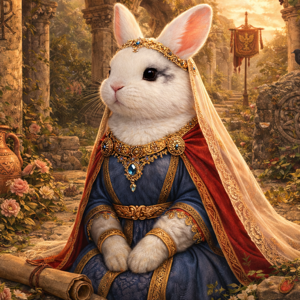
Namesake
The Story of Ennodia Magna de Rome
A Daughter at the Crossroads of Empire and Eternity
⸻
She was born in the golden hush before the storm.
The year was close to 390. The marble cities of the West still stood. Rome still imagined itself eternal. But the tremble beneath the ground—the quiet discontent in the provinces—hinted at change. Something had shifted. Something was coming.
Into this moment came Ennodia Magna, child of two mighty bloodlines.
Her father, Ennodius Felix de Rome, was Proconsul of Africa—a scholar and statesman, charged with feeding the Western Empire from the fertile fields of Carthage. Her mother, Magna de Bretagne, descended from ancient kings and crowned saints: a daughter of Macsen Wledig, the last flame of imperial might in Britain, and Elen Luyddog, the road-builder, the unifier, the saint.
Even her name, Ennodia, carried weight. In older tongues, it meant “guardian of the threshold.” And that she was.
For Ennodia would live her life on the edge of two worlds:
One dying.
One being born.
⸻
A Childhood in the Shadow of Power
Her early years were spent in villas lined with mosaics, in courtyards echoing with the dialects of Africa, Rome, and Gaul. She studied with tutors—Greek philosophy, Latin rhetoric, the Scriptures still debated in smoky councils across the empire.
At night, her mother would sing in the old tongue of the Britons—tales of saints who built roads across the land, and of a King not of this world who now sat enthroned above all earthly rulers. Her father spoke of grain quotas and governors, but in his quieter moments, of the slow unraveling he saw in letters from Rome.
“Hold fast,” he told her once. “To truth. To faith. To what cannot be taxed or taken by sword.”
⸻
A Marriage of Legacy
She was still young when she was betrothed to Anicius Probus, son of a family whose name rang through Roman history like a bell in a basilica. The Anicii—senators, judges, defenders of the faith. The match was good. Strategic. Noble.
And it was kind.
Probus was older, thoughtful, a man already watching the stars change above the empire. They shared long walks in garden cloisters, spoke of Augustine’s new writings, and prayed in silence when news came that Rome had been sacked by the Visigoths.
“Everything old is breaking,” Ennodia whispered.
“No,” Probus replied. “Everything false is falling.”
⸻
A Daughter for a Changing World
Their child came in the middle of that long unraveling.
They named her Anicia Italica—to honour both the Empire and the hope that something beautiful could still be born from it. Italica grew among scrolls and servants, bishops and broken statues. But she also grew with faith—deep and steady, shaped by the quiet dignity of her mother.
In time, Anicia would marry Adelphius of Bordeaux, moving the family’s roots deeper into Gaul—where the soil was rich and the future unknown. From their line would come bishops, abbots, and women who funded monasteries and fed the poor. Roman blood, now baptized by fire and grace.
⸻
A Life Lived Between Worlds
Ennodia lived long enough to see Carthage fall to the Vandals.
To hear that Rome’s emperors were now puppets.
To learn that some churches had turned to power just like the palaces they replaced.
She lived long enough to mourn. But not to despair.
She would rise in the mornings and walk her gardens.
She would pray with the household before breaking bread.
She would speak to her grandchildren of things that mattered—things that would endure.
Not about marble.
Not about maps.
But about the King who reigns even when kings fall.
⸻
Legacy in the Kingdom
History would forget many names.
But not hers.
Not entirely.
For in family stories and faint inscriptions, in crumbling manuscripts and whispered prayers, Ennodia Magna de Rome remains:
• A woman who bridged the old and the new.
• Who bore witness while empires fell.
• Who passed the flame, quietly, to those who would carry it into the dark.
⸻
And Perhaps… That’s the Whole Point
We look back now with all our knowledge. We see the failures—of councils, of crowns, of churchmen who grasped at power instead of kneeling in the dust.
But even in that brokenness, the Kingdom did not fall.
Because it was never theirs to carry.
It belonged to the King who wore thorns.
And it passed through women like Ennodia, who remembered.
Evidence
Inspect the historical record 1 claim on fileConnections
Analytical tools
View inheritance corridors Bird's eye view — founding corridors and continuity packets converging at this personChange projection
View through: Genealogy