person-room · Genealogy
Mechtild of Ireland
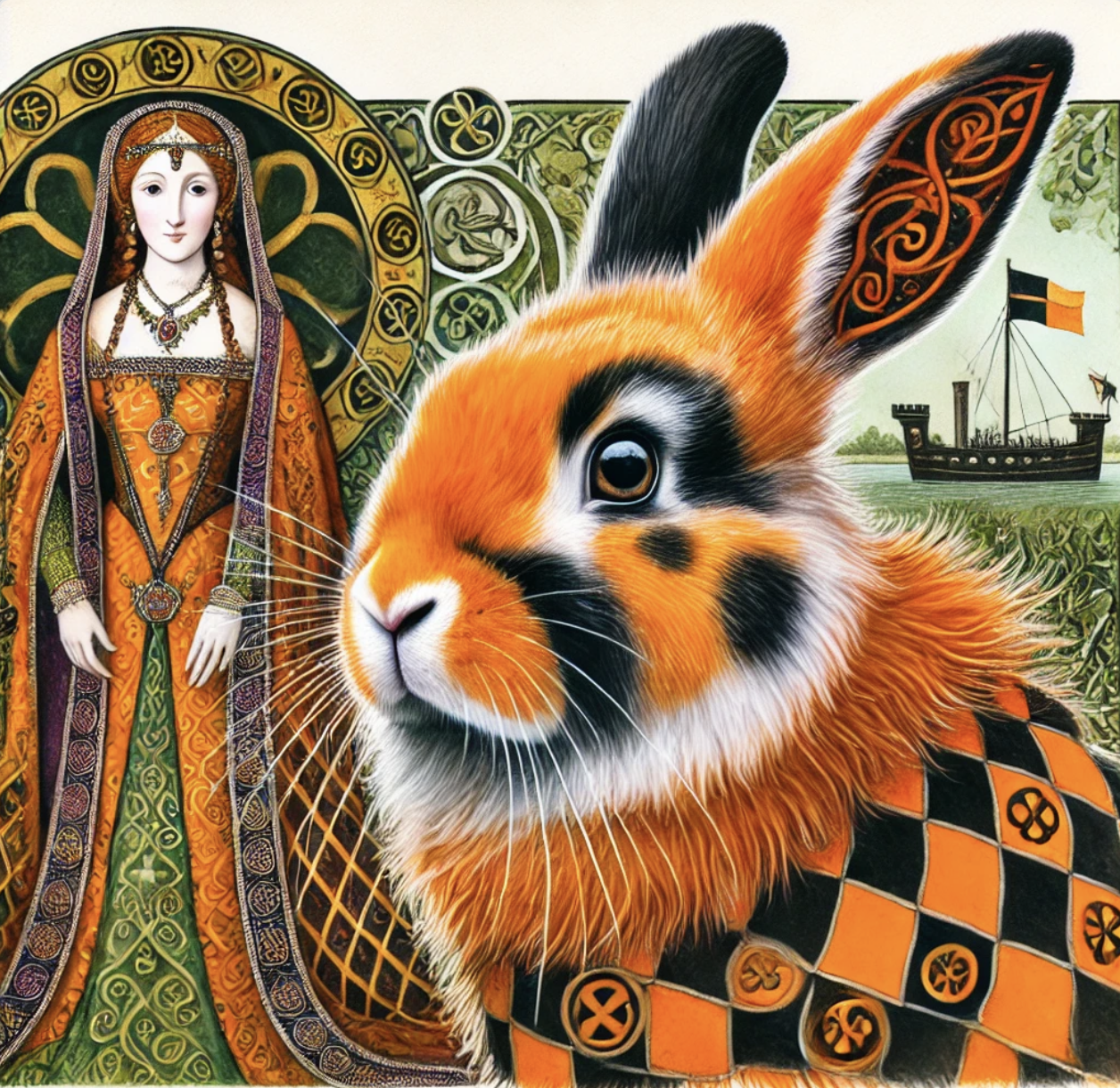
Namesake
Mechtild of Ireland:
Mechtild of Ireland, also referred to as Mechtilde or Mechtildis, is a somewhat obscure figure in historical texts. The use of “Ireland” indicates her Irish origins, possibly connected to the Gaelic nobility. During the early medieval period, Ireland had numerous small kingdoms and clans, and its nobility often intermarried with other European royal families to forge alliances and strengthen ties.
If Mechtild of Ireland is indeed linked to Dagobert II as a cousin, it implies that she belonged to a prominent Irish family with connections to the Merovingian dynasty, the ruling family of the Franks. The Merovingians were known for their strategic marriages across European noble houses, including those in Ireland and Britain, to secure alliances and consolidate power.
Dagobert II, Roi d’Austrasie:
Dagobert II (c. 650–679 AD) was a king of the Merovingian dynasty who ruled Austrasia, the eastern part of the Frankish kingdom, from 676 until his death in 679. He was the son of Sigebert III and was a descendant of Clovis I, the first King of the Franks to unite all the Frankish tribes under one ruler.
Dagobert II’s early life was marked by political intrigue. After his father’s death, he was overthrown by the Mayor of the Palace, Grimoald, and exiled to an Irish monastery, where he spent a significant portion of his youth. During his time in Ireland, he would have been exposed to Irish culture and possibly formed familial and political alliances with Irish nobility.
Dagobert was later restored to the throne of Austrasia, with the support of various factions in the Frankish kingdom. His short reign was focused on restoring royal authority and addressing the challenges posed by internal factions and external threats. However, his reign ended abruptly when he was assassinated in 679, under circumstances that remain mysterious but were likely connected to the power struggles within the Frankish nobility.
During this period of exile, it is possible that Dagobert formed a relationship with Mechtild of Ireland, resulting in the birth of their daughter, Adela d’Austrasia. This relationship underscores the deep historical ties between Ireland and the Merovingian dynasty and reflects the complex network of political alliances and familial connections that characterized early medieval Europe.
Adela d’Austrasia
Adela d’Austrasia was the daughter of Dagobert II and Mechtild of Ireland. Her birth would have carried significant implications for both Irish and Frankish politics, given her dual heritage. As the daughter of a Merovingian king, Adela would have been seen as a valuable figure in the dynastic politics of the time, especially given the Merovingians’ extensive network of noble alliances across Europe.
Marriage to Odo the Great
Adela d’Austrasia married Odo the Great (also known as Eudes), who was Duke of Aquitaine and Gascony. Odo was a significant figure in the early medieval period, known for his strong opposition to both the Merovingian kings and the Umayyad Caliphate’s expansion into Europe. His rule was marked by a period of relative independence for Aquitaine, a region in southwestern France that sought to maintain its autonomy amidst the broader power struggles of the time.
Odo the Great, Duke of Aquitaine and Gascony
Odo the Great (c. 680–735 AD) became Duke of Aquitaine and Gascony around 700 AD and is best known for his victory against the Umayyad forces at the Battle of Toulouse in 721. This battle was a significant event in the history of the Frankish kingdoms, as it marked one of the early major defeats of the Umayyad expansion into Europe. Odo’s leadership and military acumen were critical in maintaining the independence of his duchy during a time of external threats and internal Frankish conflicts.
Odo’s marriage to Adela d’Austrasia would have been a strategic alliance that linked his powerful duchy in the southwest with the Merovingian royal family. This marriage helped to strengthen Odo’s position by aligning him with the royal bloodline, enhancing his legitimacy and influence both within and beyond Aquitaine.
Significance of the Alliance
The marriage between Adela d’Austrasia and Odo the Great highlights the strategic importance of marital alliances in medieval European politics. Through this marriage, the Merovingian and Aquitainian lines were united, blending Irish, Frankish, and Aquitainian influences. This alliance would have helped to bolster Odo’s political standing and secured important support from factions loyal to the Merovingian dynasty.
For Adela, her marriage to Odo the Great represented an elevation in status and influence, positioning her at the center of Aquitainian politics. As Duchess of Aquitaine, she would have had a role in managing the duchy’s affairs, especially given the relative independence of Aquitaine from the Frankish crown during Odo’s reign.
Legacy
Adela and Odo’s union brought together multiple noble and royal lineages, reflecting the interconnected nature of medieval European nobility. Their descendants would continue to play significant roles in the politics of France and beyond, contributing to the rich tapestry of medieval European history.
The story of Mechtild of Ireland, her relationship with Dagobert II, and the marriage of their daughter Adela to Odo the Great illustrate the complex web of alliances and familial ties that defined early medieval European politics. These connections were not only significant for their immediate political implications but also for their long-term impact on the region’s history and the shaping of European noble lineages.
Evidence
Inspect the historical record 1 claim on fileConnections
Analytical tools
View inheritance corridors Bird's eye view — founding corridors and continuity packets converging at this personChange projection
View through: Genealogy